The most successful people in the world have built empires, and quietly lost themselves in the process.
John Rees-Evans has spent a lifetime doing the opposite. He is available to help you do the same.
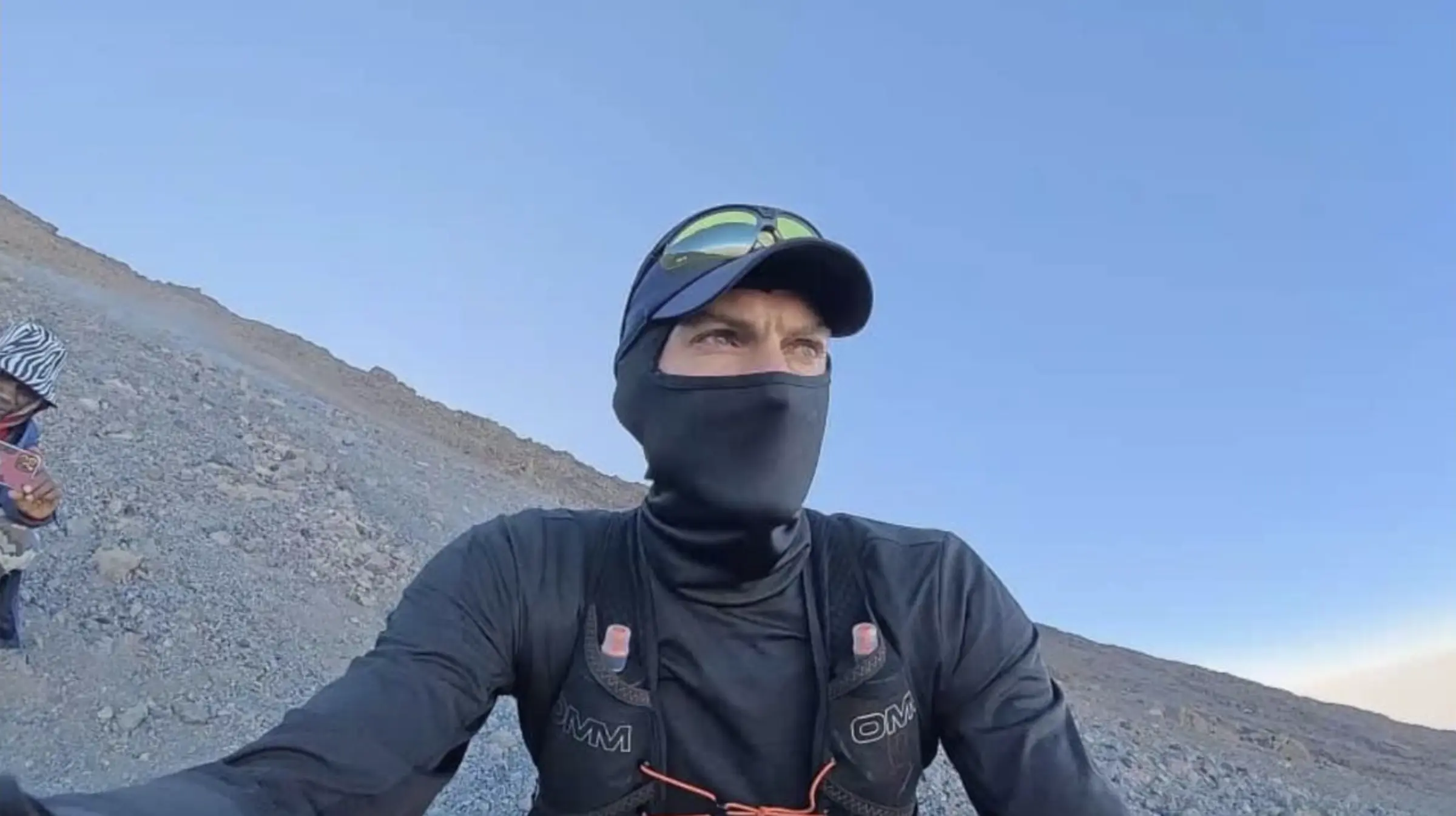
About JRE
A life in unrelenting pursuit of excellence.
John Rees-Evans is 48, a father of five, and on 7 July 2026 became the first person to complete the ascent and descent of the full mountain of Kilimanjaro, from its true geographic base at 777 metres to Uhuru Peak at 5,895 metres and back, in a single continuous effort of 23 hours, 58 minutes and 1 second.
Mountains and continental crossings are not the point. They are the proof. They prove that the human body and mind, correctly trained, disciplined and fuelled, are capable of far more than comfort leads us to believe. John has been proving this his entire life: not in youth, not with favourable genetics, and not with the artificial advantages of a professional athlete’s schedule. He is 48. He has five children. His training fits around a life, not the other way around.
At 19, he cycled solo from Geneva to Jerusalem, approximately 3,000 miles in 21 days, crossing borders the Foreign Office considered inadvisable. That same year he completed a continuous north-to-south traverse of Jostedalsbreen, the largest glacier in mainland Europe, in under 24 hours. He later completed an unbroken overland and cycling line from California to Jerusalem, broken only by the Atlantic. He has made an unsupported, no-supplemental-oxygen attempt on Everest’s north face. He founded Team Kilimanjaro in 2004 and has operated on the mountain ever since.
He holds the UK unsupported Kilimanjaro speed ascent record from the park gate. He considers it an incomplete measure of the mountain. He has now set a better one, and ten days later he rode once round it.
Field log
Key expeditions and records.
Geneva to Jerusalem by bicycle
Solo and unsupported, approximately 3,000 miles in 21 days. Age 19. Borders the Foreign Office advised against. No GPS, no support vehicle.
Jostedalsbreen: full traverse in under 24 hours
With Neil Tucker: a continuous north-to-south traverse of the largest glacier in mainland Europe, completed in under 24 hours.
California to Jerusalem: the overland line completed
Los Angeles to New York by bicycle, then Lisbon to Aix-en-Provence, completing an unbroken overland line from California to Jerusalem begun in Switzerland three years earlier. Unsupported throughout.
Everest north face: unsupported, no supplemental oxygen
An attempt on Everest’s north face by the Hornbein Couloir, unsupported and without supplemental oxygen.
Team Kilimanjaro founded
Founded Team Kilimanjaro on 30 June 2004. It has run climbs on the mountain ever since, on routes of its own design built for better acclimatisation and safety: TK Lemosho, TK Machame, TK Rongai and TK Umbwe.
UK unsupported Kilimanjaro speed record
10 hours 25 minutes 20 seconds. Unacclimatised, solo, unsupported, Marangu Gate to Uhuru Peak. John considers this an incomplete measure: the gate is a political boundary, not the base of the mountain.
Youngest person on record to summit Kilimanjaro
John organised the expedition that placed Bran Rees-Evans, one of his five children, on the summit at 5 years and 136 days, the youngest summiteer on record.
World first: the full Kilimanjaro, true base to summit and back, under 24 hours
7 July 2026. 23 hours, 58 minutes, 1 second. From the lowest point on the perimeter road (777 m) to Uhuru Peak (5,895 m) and back, by bicycle and on foot. The first complete ascent and descent of the world’s largest freestanding mountain from its true geographic base. Age 48.
Full route and data ›World first: sub-24-hour manpower circumnavigation of Kilimanjaro
17 July 2026. 15 hours, 50 minutes, 4 seconds. Once round the perimeter road of the world’s largest freestanding mountain, 232.06 km and 3,006 m of gain, by bicycle, anti-clockwise from the same 777 m point at Mabungo. Ten days after the base-to-summit record, and 8 hours 10 minutes inside the 24-hour target.
Route, breaks and data ›The record · 7 July 2026
The complete mountain. No shortcuts. No excuses.
Every previous Kilimanjaro speed record began at the park gate, an administrative line about 1,081 vertical metres above the true base of the mountain. It exists because private farmland lies below the forest. It is a land-tenure boundary, not a geographic one. John Rees-Evans did not accept it as the start of the mountain.
On 7 July 2026, starting at midnight at Mabungo village on the 777-metre perimeter road, John cycled to Marangu Village, ran to Marangu Gate, and climbed the Marangu Route in full: Mandara Hut, Horombo Hut, Kibo Hut, Gilman’s Point, Stella Point, Uhuru Peak. He descended to Kibo Hut, collected a second bicycle staged in advance, and rode the service road by Maua Gate back to the 777-metre base. Guides rotated at the huts and cooks were staged at each one. No supplemental oxygen. Age 48.
The round trip, 5,118 metres from base to summit and 117 kilometres in all, was completed in 23 hours, 58 minutes and 1 second: the first recorded completion of the full mountain from its true geographic base in under 24 hours.
Personal performance mentorship
For people who have built everything, and quietly lost the edge that built it.
Success has a paradox at its centre. The harder you worked to build your business or career, the more likely you are to have delegated your body, your discipline and your daily habits to a future version of yourself who never quite arrives.
John Rees-Evans has seen this pattern again and again on mountains. Highly successful people, executives, founders and leaders, arrive physically unprepared not because they lack intelligence or drive, but because nobody in their lives has been given authority to challenge them directly. Their world has rearranged itself around their preferences. People agree with them. Problems are resolved before they reach them. And gradually, imperceptibly, the discipline that built the empire begins to erode.
The result is rarely dramatic. It is weight that appeared slowly. Sleep that deteriorated. Energy that is not quite what it was. A quiet acceptance that the best years of physical performance are simply behind them: accepted, not chosen.
John does not accept that framing. At 48, with under 6% body fat and a 23-hour-58-minute traverse of the world’s largest freestanding mountain behind him, he is not trading on past achievement. The methods work. And they are not the province of the young.
The honest assessment
John comes to your location and observes, not to be polite, but to understand exactly where you are: weight, sleep, diet, daily structure, the habits you have allowed to slide. He will tell you what he sees. Most people in your life will not.
The physical recalibration
Early mornings. Running, on a beach, up a hill, wherever you are. Dietary discipline that is practical, not theoretical. Not a plan on paper but someone who is there at 5am and runs alongside you until the habit forms. You will have heard that a habit takes 21 days; studies put the average nearer two months. The reality depends on the person.
The mental discipline
Physical performance and mental clarity are not separate. Leaders who train consistently do so because it is the most reliable way to improve decision-making, resilience and the capacity to operate under pressure. John has worked in high-stakes environments for three decades. He understands what this looks like from the inside.
The perspective shift
Where it fits, clients are invited to experience something genuinely different: time with the Hadzabe of Tanzania, who live cheerfully while owning almost nothing, or a mountain challenge calibrated to the individual. Not tourism. A deliberate confrontation with what you are actually capable of when comfort is removed.
This is a significant commitment for John, typically a minimum of three weeks at the client’s location, priced accordingly. The value of restoring health, discipline and daily structure compounds across every other area of life. John will not take every engagement. He will be direct with you about whether he believes he can help.
Enquiries: 777@johnreesevans.com
Perspective
John Rees-Evans“We sometimes take clients to spend time with the Hadzabe, who live cheerfully while owning just a knife, a woven sack and a pair of cut-off trousers. This tends to be mind-expanding for people who have everything.”
Expedition destinations
Mountains John Rees-Evans works on.
Kilimanjaro
The world’s largest freestanding mountain and John’s primary mountain. Team Kilimanjaro has run climbs here since 2004, with a 97.6% summit success rate. Both 777 records were set here in July 2026.
Toubkal and the Atlas
North Africa’s highest peak and its satellite summits in the High Atlas. Team Toubkal operates year-round from Marrakesh into the Atlas highlands.
Everest region
Everest Base Camp and trekking peaks across the Himalaya. John has also made an unsupported, no-supplemental-oxygen attempt on Everest’s north face by the Hornbein Couloir.
Complex expeditions
Multi-stage competitive expeditions, desert traverses, circumnavigations and bespoke performance challenges. Previous examples include the Euro Man of Steel, a 106 km run, English Channel kayak crossing and Alpine cycle-climb, assisted by Sir Ranulph Fiennes.
Enquiries
Work with John Rees-Evans.
For personal performance mentorship, VIP expedition leadership, or the 777 Summit Challenge, contact John directly.
777@johnreesevans.com